Droodles
2025-04-03
BackIn 1953, Roger Price published a collection of small square drawings captioned with deadpan titles that did not explain what you were looking at. A few black lines, a punchline, the joke happening entirely in the gap between the two. He called them Droodles.
They were a minor craze for a decade and then mostly vanished. Price went on to co-create Mad Libs, which kept his name in print; the droodles became one of those small cultural artifacts you only really encounter if someone hands you a book. Someone handed me a book.
A droodle is a riddle in two parts. You see the drawing first, try to figure out what it depicts, then read the caption to learn how wrong, or surprisingly right, your guess was. Some are pure geometry. Some are weirdly profound. None of them can be solved by reasoning.
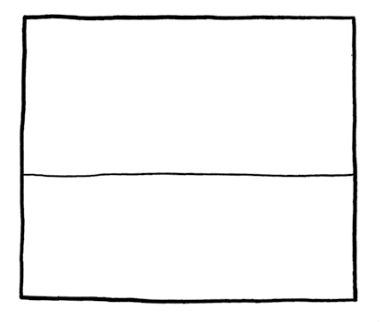
A SCENE IN TEXAS
I wanted a matching game out of them: a grid of drawings on one side, a shuffled set of captions on the other. Simple mechanic, but the content does the work. You cannot guess these by logic; every match is either obvious in retrospect or completely impossible.
The more interesting part of building it was getting the droodles out of the book. I scanned each page, ran an OpenCV pipeline that detects rectangular regions matching the panel dimensions, and OCR'd the caption strip beneath each one. After cleanup that gave me roughly three hundred image-caption pairs as a single JSON. The game on top of that file is a few dozen lines of Svelte.
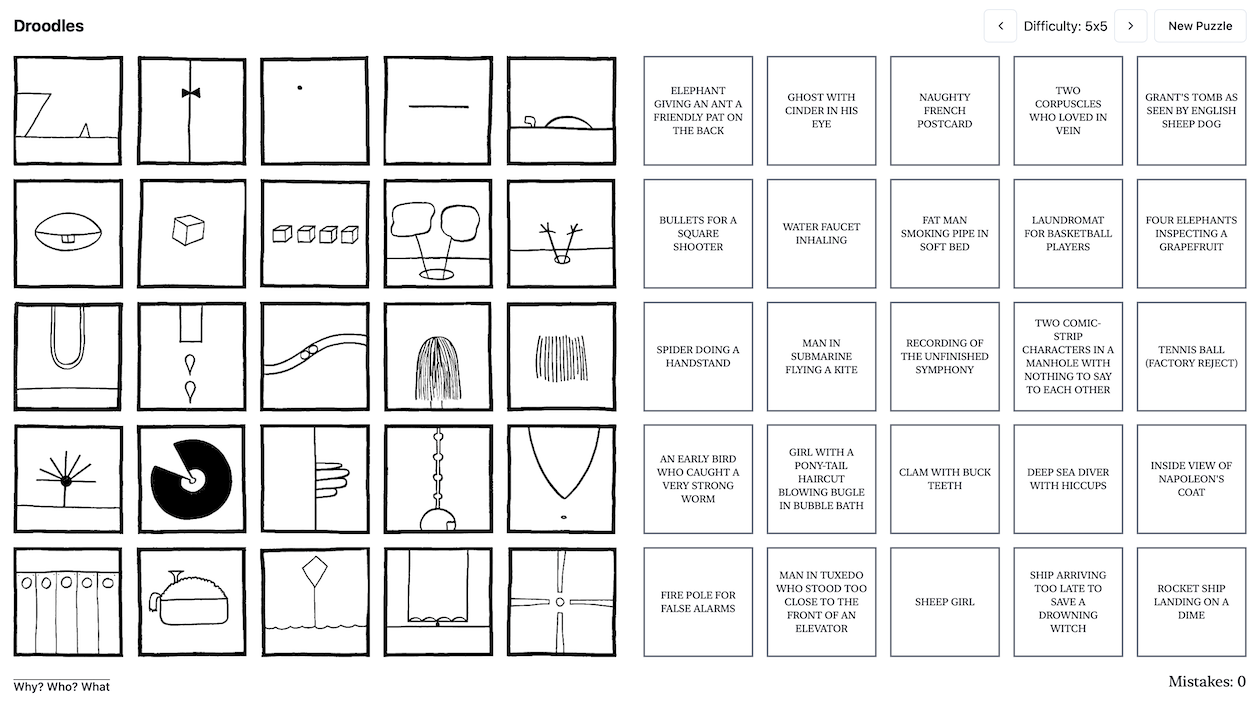
Live at droodles.ma-r-s.com. Source on GitHub. Difficulty slider controls the grid size, 3×3 up to 8×8.
CC BY-NC 4.0 © ma-r-s
?